
Jilibdt KYC Policies and Identity Verification Standards
Identity verification plays a critical role in maintaining a safe, fair, and compliant online betting environment. By confirming user identities, platforms can prevent fraud, protect player funds, and comply with international regulatory standards. Clear KYC rules also help ensure that all users are treated equally. The jilibdt KYC Policies outline how identity verification is conducted, what documents are required, and why this process is essential for account security and financial integrity.

Purpose and Scope of the KYC Framework
KYC procedures are designed to verify that users are genuine, eligible, and acting in good faith. These measures help reduce financial crime and protect both players and the platform from misuse.

The Jilibdt KYC Policies apply to all registered users who access betting services, deposit funds, or request withdrawals.
Why identity verification is required
Verification helps prevent identity theft, multiple account abuse, and underage participation. It also ensures that funds are paid out only to the rightful account holder.
These safeguards are essential components of the Jilibdt KYC Policies and support long-term platform integrity.
Who must complete KYC verification
All users may be required to complete verification at different stages of account usage. Verification is typically mandatory before withdrawals are approved.
Additional checks may be requested based on transaction activity or regulatory requirements.
Information Collected During the KYC Process

KYC verification requires specific personal information to confirm identity accurately. Only information necessary for verification and compliance is collected.
The Jilibdt KYC Policies clearly define the types of information required and how they are handled.
Personal identity details
Users are asked to provide personal details that match official identification records. This information helps establish a verified identity.
Commonly required details include:
- Full legal name
- Date of birth
- Nationality
- Registered contact information
Official identification documents
Supporting documents are required to validate the provided personal details. These documents must be valid, clear, and unaltered.
Accepted documents may include:
- National identity card
- Passport
- Other government-issued identification
Address and Payment Verification Requirements

In some cases, additional verification is required to confirm residential address or payment ownership. These checks help strengthen fraud prevention measures.
The Jilibdt KYC Policies include address and payment verification as part of enhanced due diligence.
Proof of address documentation
Proof of address confirms the user’s place of residence and supports regulatory compliance. Documents must show the user’s name and address clearly.
Commonly accepted proof of address documents include:
- Utility bills
- Bank statements
- Official government correspondence
Payment method ownership verification
Payment verification ensures that deposits and withdrawals are linked to the verified user. This reduces the risk of unauthorized transactions.
Users may be asked to provide screenshots or confirmations showing ownership of payment accounts.
KYC Submission and Verification Process
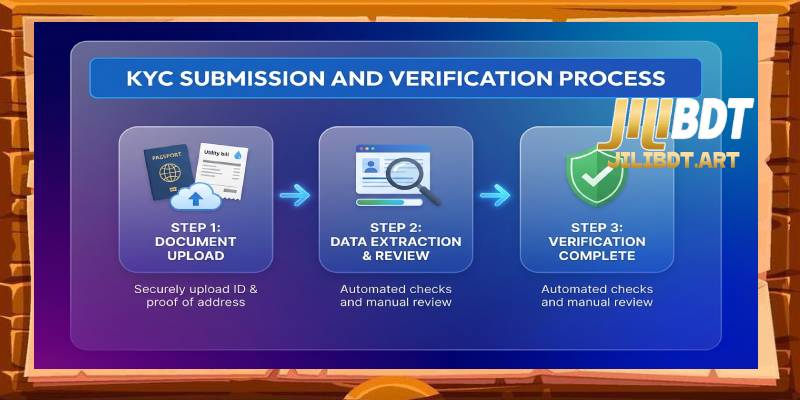
The verification process follows a structured workflow to ensure accuracy and consistency. Clear steps help users complete KYC efficiently.
The Jilibdt KYC Policies define how documents should be submitted and reviewed.
How to submit KYC documents
Users submit verification documents through secure account sections. Uploaded files must be clear and readable.
Following submission guidelines helps avoid delays during review.
Verification review timeline
Once documents are submitted, they enter a review queue. Most verifications are completed within a reasonable timeframe.
Complex cases or incomplete submissions may require additional review time.
Account Restrictions Before Verification

Certain account features may be limited until verification is completed. These restrictions are applied to protect both users and the platform.
The Jilibdt KYC Policies clearly define what actions may be restricted before approval.
Withdrawal limitations
Withdrawals are typically not permitted until identity verification is completed. This ensures funds are released only to verified individuals.
Deposit and gameplay access may still be available during this period.
Transaction monitoring
Accounts awaiting verification may be subject to enhanced monitoring. This helps detect irregular activity early.
Monitoring protects both users and platform resources.
Data Protection and Privacy During KYC

KYC data contains sensitive personal information and must be protected accordingly. Strong security measures are applied throughout the verification process.
The Jilibdt KYC Policies align with established privacy and data protection standards.
Secure storage of verification data
Verification documents are stored in encrypted environments with restricted access. Only authorized personnel can review KYC information.
Security controls are reviewed regularly to address emerging risks.
Limited use of KYC information
Collected information is used solely for verification, compliance, and security purposes. Data is not shared for marketing or unrelated activities.
This controlled use supports user trust and regulatory compliance.
Enhanced Due Diligence and Ongoing Monitoring

In certain cases, enhanced verification may be required based on risk indicators. These additional checks help maintain system integrity.
The Jilibdt KYC Policies allow for ongoing monitoring to ensure continued compliance.
High-value or unusual activity reviews
Accounts with unusually high transaction volumes or irregular behavior may undergo additional checks. This helps prevent financial crime.
Reviews are conducted fairly and based on objective criteria.
Periodic KYC updates
Users may be asked to update verification documents if information becomes outdated. Keeping records current supports ongoing security.
Requests for updates are communicated clearly through official channels.
Consequences of Non-Compliance

Failure to complete KYC requirements may result in account restrictions. These measures are necessary to meet legal obligations.
The Jilibdt KYC Policies outline potential consequences clearly.
Temporary account suspension
Accounts may be temporarily suspended if verification requests are ignored. Access can be restored once requirements are met.
Suspension is used as a protective measure rather than a penalty.
Permanent account closure
In serious cases involving false information or repeated non-compliance, accounts may be permanently closed.
Such actions are taken only after thorough review.
Policy Updates and User Responsibilities

KYC requirements may change to reflect regulatory updates or security improvements. Staying informed helps users remain compliant.
The Jilibdt KYC Policies are reviewed periodically to ensure effectiveness.
Notification of changes
Significant policy updates may be communicated through official announcements. Continued use indicates acceptance of updated terms.
Users are encouraged to review policy updates regularly.
User cooperation and accuracy
Providing accurate and up-to-date information is the user’s responsibility. Cooperation helps ensure smooth verification.
Responsible participation supports a secure platform environment.
Clear Verification Rules for a Secure Environment

A well-defined KYC framework protects users, supports compliance, and strengthens trust. Clear rules help set expectations and reduce disputes. The Jilibdt KYC Policies reflect a commitment to secure, transparent, and responsible identity verification practices for all users.